

Blue Blasters
Have Gun Will Travel
STRIKE FIGHTER SQUADRON 34 COMMAND HISTORY
The Blue Blasters, originally commissioned as VF-20 “Jokers” in 1943, were heavily involved in key World War II battles, including the sinking of the IJNS Musashi and action at Leyte Gulf. After the war, they transitioned through several aircraft and designations, becoming VF-34 in 1950 and then VA-34 in 1955. The squadron operated A-4 Skyhawks and deployed to the Mediterranean, earning their “Blue Blasters” nickname for their nuclear strike capabilities.
During the Vietnam War, VA-34 participated in operations over North Vietnam from the deck of USS Intrepid before being disbanded in 1969. Reestablished in 1970 as an A-6 Intruder squadron, the Blue Blasters continued to distinguish themselves, participating in high-profile operations like PRAIRIE FIRE and EL DORADO CANYON in the 1980s, where they were the first to employ the HARPOON missile in combat.
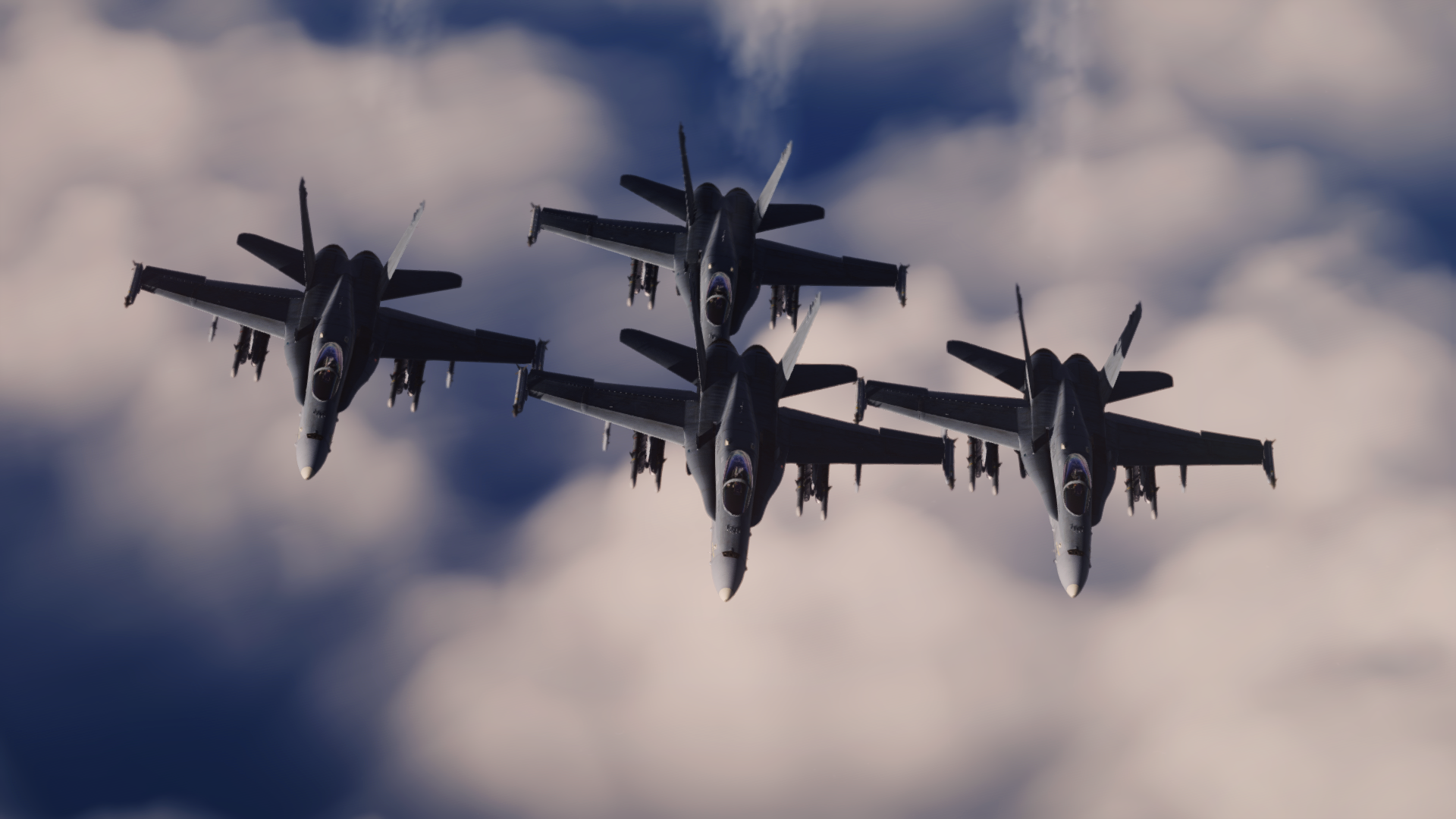
The squadron transitioned to the F/A-18C Hornet in 1996, becoming VFA-34. They deployed aboard USS George Washington for its maiden cruise in 1994 and continued to support operations in Bosnia, Iraq, and other global conflict zones. By 2000, VFA-34 had established itself as one of the Navy’s top strike fighter squadrons, known for its operational achievements and combat readiness.
In reality VFA-34 was the last hornet squadron to join CVW-17 in the mid 90s, after VFA-81 and VFA-83 who had already been assigned to CVW-17 since before the first gulf war.
In Virtual Carrier Air Wing 17 however the Blue Blasters were the first Hornet squadron within CVW-17. The Blue Blasters represent CVW-17s Senior hornet core. Over the years the Blue Blasters have established themselves as the premier Strike Fighter Squadron within the Air Wing.
VFA-34 has participated in Operation Persian Sabre in 2022, Operation Enduring Freedom in 2023, Operation Northern Shield in 2024 and most recently Operation Resolute Passage in 2025.
Within CVW-17 and Navy air wings more generally none of the Squadrons hold any particular specalisations. All squadrons Hornets and Tomcats train to the same tactics and standards. However there are so called “SME Squadrons” whose leadership holds a certain expertise in a mission set, that they provide when required. For VFA-34 the SME role for SEAD is currently held.
-
The Commanding Officer of VFA-34 approaches leadership with a strong emphasis on preparation, continuous improvement, and developing the people around him. After years of flying across a variety of aircraft in DCS, he joined vCVW-17 seeking a more challenging environment in which realistic procedures, disciplined execution, and teamwork were central to mission success. As Commanding Officer of the “Blue Blasters,” he works to foster a squadron culture where members are encouraged to challenge themselves, learn from mistakes, and actively contribute to the development of their fellow aviators. He believes that demanding missions are most rewarding when the squadron has invested the time and effort necessary to execute them well. His leadership philosophy emphasizes thorough preparation, constructive feedback, mentorship, and personal accountability while maintaining an environment in which members enjoy the process of learning and improving. His goal for VFA-34 is not simply to successfully complete assigned missions, but to continually develop more capable virtual naval aviators, stronger teammates, and a better squadron. A lifelong aviation enthusiast, he continues to approach DCS with the same curiosity that originally drew him to military aviation - although he maintains that Iron Eagle was, objectively, a horrible movie.
-
Born in a city home to a joint U.S.-Spanish air force base, the XO of VFA-34 spent his early years looking up in awe at the familiar sight of sections of Hornets and Vipers flying overhead, along with the occasional “accidental” sonic boom. With no Internet and whatever Jane’s books he could get his hands on as his only guides (yes, kids, this guy has some gray hair on his face), he strove to learn as much as he could about military aviation in general and naval aviation in particular.
With his first PC came his first simulator, MicroProse’s F-14 Fleet Defender, the first of a number of now-ancient flight simulators. Fast forward to 2019, and he found himself the proud owner of a VR headset and decided to give this DCS thing a go. The rest, as they say, is history.
The XO joined CVW-17 in 2024 looking for a place where the standard was to do things the right way. He found that and much more: a place with a vast wealth of accumulated tribal knowledge, where everyone strives to improve at every turn and genuinely enjoys the process of studying, planning, training, and gitting gud as much as the end result itself.
He is grateful to be able to give something back to this community by serving as XO, a role in which his focus remains on building and maintaining the squadron’s readiness to execute its share of the air wing’s tasking during deployment, while also keeping this hobby of ours as interesting and rewarding as possible for the members of the squadron.
The XO is a firm believer in the value of thorough preparation, repeated training, and honest debriefing, where constructive feedback can be both given and received as the valuable gift it is. That goes both ways: he knows he still has much to learn and takes pride in trying to do so on every sortie.


VFA-34 MISSIONS
-
"Bombs on Target, On Time" is VFA-34's mantra for strike missions. Equipped with advanced targeting systems like the AN/ASQ-228 ATFLIR, VFA-34’s F/A-18C Hornets can accurately deliver precision-guided munitions, including laser-guided and GPS-guided bombs, ensuring effective strikes in support of mission objectives.
-
During Offensive Counter Air (OCA) missions, VFA-34 provides sweep and escort for strike packages, enhancing air superiority in hostile airspace. The F/A-18C’s agility, powerful radar, and air-to-air missile capabilities enable VFA-34 to clear threats and protect high-value assets, ensuring mission success in contested environments.
-
VFA-34 plays a key role in SEAD missions, using the F/A-18C’s capabilities to neutralize enemy radar and missile systems. Armed with AGM-88 HARM missiles, the Hornets can locate and suppress hostile air defenses, paving the way for friendly aircraft and enabling safe access to contested airspace.
-
In Close Air Support missions, VFA-34’s F/A-18C Hornets provide timely and precise firepower to support ground forces. With versatile weapons loadouts and the ability to quickly acquire targets using ATFLIR, VFA-34 can adapt to dynamic ground scenarios, delivering ordnance with high accuracy to support JTACs and ground commanders.
-
In War at Sea missions (WAS), VFA-34’s F/A-18C Hornets are equipped with the AGM-84 Harpoon missile to engage surface threats at long range. Leveraging the Harpoon’s sea-skimming flight profile and precision targeting, VFA-34 can effectively strike enemy ships, neutralizing high-value maritime targets and contributing to naval superiority in contested waters.